


Broadcasting, How To Live Stream

If you've been around the world of technology for any amount of time, you're certainly no stranger to complicated acronyms. AI and LLMs seem to show up everywhere we go. You're likely required to use MFA regularly whether you like it or not, and maybe you've even read through an API or SDK when you wanted to understand software more intimately or customize it to your workflow.
The world of streaming is no different. A few core acronyms are vital for any broadcaster looking to keep their live content crisp and cutting-edge. It's helpful to occasionally review these in detail to ensure you're using the best available technology.
This blog will focus on one key industry term: the H.265 codec. We'll explain what it really means, how it works, and describe why it matters a great deal for your live online events.
What’s a Codec, Anyway?
What’s HEVC Got To Do With It?
But What About 2020?
Final Thoughts
The term codec is often unfamiliar and can be confusing, especially for streamers who don't have formal video training. Let’s start with a clear definition, then break down what it does.
A codec is software or hardware that encodes or decodes data in order to compress and decompress it.
To start, it's important to know that a codec can exist as software on a device or as a dedicated piece of hardware. Its job is to make large files smaller through compression and then expand them through decompression. The term shows up most in the world of audio and video because raw AV files are huge, so it makes sense to make them smaller for easier transmission, streaming, and then restore them back to full size for playback.
In the 1990s and early 2000s, standard definition video was common, using a 4:3 aspect ratio at 480p resolution. A major shift in video technology began around 2006, when 16:9 widescreen TVs became the new standard. This change led to a corresponding explosion of high-definition (HD) content for movies, television, and video games.
This meant video data got larger, and it also meant viewers subconsciously developed an appetite for flawless HD content whether they were watching on demand or live.
All of this gets back to why a codec matters in live video streaming. Sending huge raw files of video and audio with little to no latency so viewers get the perfect HD picture they expect is incredibly hard. Compressing the data to a smaller size for transport and then decompressing it so it displays in all its glory is exactly what a codec exists to do.
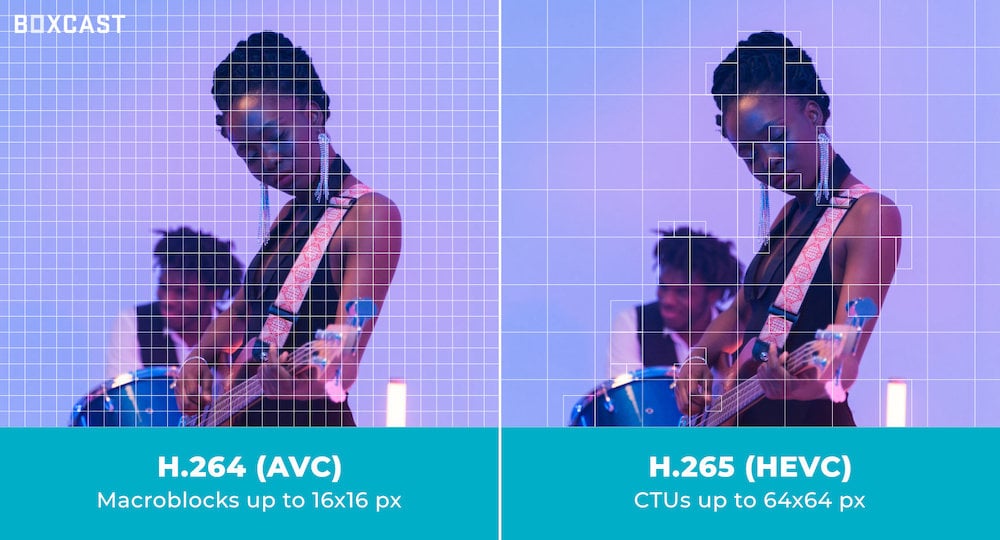
Now that we’ve established what a codec is, it’s time to focus on H.265. You may notice this section title mentions HEVC. This stands for High Efficiency Video Coding and is simply the formal name for the H.265 standard. For all practical purposes, H.265 and HEVC refer to the same technology.
HEVC is the next generation version of H.264, which was known as AVC, or Advanced Video Codec. AVC came out in 2003, while HEVC arrived a decade later in 2013. Remember, in 2003 we lived in a standard definition world, so H.264 had solid compression efficiency for 480p SD video. But into the twenty-teens, HD was everywhere, and video files were much larger. That meant these larger files needed stronger compression, and devices needed more processing power to handle it.
That’s the strength of H.265 and why the words “high efficiency” are baked into its name. Compared to its predecessor in H.264, it offers roughly twice the compression efficiency, because quite frankly, HD video streaming demanded it.
HEVC improved upon its predecessor, AVC, as resolution standards advanced. While HEVC was introduced in 2013, technological innovation has continued rapidly since then. The year 2020 marked a major development with the arrival of VVC (Versatile Video Coding), also known as H.266.
VVC followed a similar pattern as its predecessor and improved compression by roughly 30% to 50% from HEVC, depending on who’s counting. There’s a bit of a catch with H.266, though. It only achieves this increased compression through advanced processes that require far higher computational complexity for both encoding and decoding. Another drawback is that it takes much longer to encode compared to HEVC H.265.
All of this is a big deal for live video streaming because low computational requirements and fast compression and decompression speed are absolute musts. And it might surprise you, but as of 2026 broadcast television still uses 1080i, and even though OTT apps like Netflix and Disney Plus offer 4K titles, most of their libraries still sit at 1080p.
Putting all of this together, most of the content people watch, even if they have a 4K TV, is still 1080 resolution, if not lower. That means the tradeoffs of VVC are rarely worth it. The boost in compression is nice on paper, but HEVC already handles 1080p beautifully with far fewer downsides.
We would also be amiss not to mention another codec that showed up in 2018 called AV1, or Alliance for Open Media Video 1. It follows the same general pattern as VVC H.266 with a 30% to 50% compression improvement. It also comes with slower encoding and decoding, so unless you have much higher computational resources or if low latency doesn’t matter to your context, AV1 still isn't the ideal choice for most live streaming workflows.
You now have a clear understanding of the H.265 codec and its vital role in modern live streaming. Its superior compression is key to delivering a sharp, professional broadcast to your audience. However, a great codec is only one part of the equation.
To complete your high-efficiency workflow, you need a powerful delivery mechanism. Learn more about how to maximize your H.265 performance by checking out our recommendation for the best live streaming protocol to pair with HEVC.


